Ask three different roof cleaning companies which method they use and you’ll often get three different answers and at least one of them selling you the wrong one for your roof. Soft washing and pressure washing get thrown around almost interchangeably in quotes and adverts, but they’re genuinely different processes, with different tools, different risks, and very different long-term results.
If you’re comparing quotes for your Bournemouth property and one company mentions “soft wash” while another simply says “pressure wash your roof,” it’s worth understanding exactly what that distinction means before you book anyone in because on the wrong roof, the wrong method can do real damage.
What’s the Actual Difference?
The simplest way to think about it: pressure washing removes moss and dirt through force, while soft washing removes it through chemistry.
| Soft Washing | Pressure Washing | |
|---|---|---|
| Water pressure | Very low (roughly garden-hose level, 100–300 PSI) | High (1,300-4,000+ PSI) |
| How it works | Biocide/algaecide solution breaks down moss and algae at cellular level, then gets rinsed away | High-pressure water physically blasts growth off the surface |
| Kills the roots? | Yes , treats spores and roots, slows regrowth | No , removes visible growth only, roots often survive |
| Risk to tiles | Very low, safe for fragile and aged materials | Higher, can lift granules, crack tiles, force water under tiles |
| Typical results last | 2-4 years | 6-18 months before regrowth returns |
| Best suited to | Clay, slate, aged concrete, listed properties | Sound, durable modern concrete tile in good condition |
| Cost | Slightly higher upfront | Often cheaper on paper |
Both processes fall under the umbrella of what most people search for as “roof cleaning,” but they’re not interchangeable, and a contractor who doesn’t ask which one you need before quoting is a red flag worth noting.
How Soft Washing Actually Works
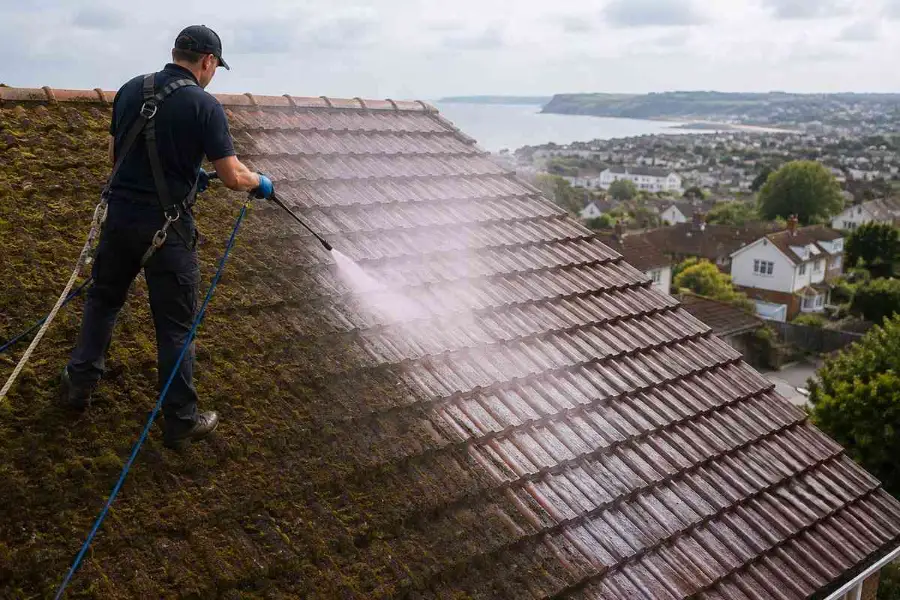
Soft washing uses a specialist low-pressure system either a dedicated pump and tank or a pressure washer fitted with a low-pressure downstream nozzle to apply a diluted biocide solution across the roof surface. The solution is left to dwell for a period, giving it time to break down moss, algae and lichen at the cellular level, before being rinsed off with low-pressure water.
The key advantage here is that soft washing doesn’t just remove what you can see. Moss and algae spread through spores and root structures embedded in the tile surface, and force alone won’t touch those. A proper soft wash disrupts that biological growth at the source, which is why the results tend to hold for years rather than months.
A soft wash roof clean isn’t measured by how clean the roof looks the moment the technician leaves it’s measured by how clean it still looks eighteen months later. That’s the real test of whether the treatment worked or just moved the problem around.
This is also the method most commonly recommended for coastal properties. Bournemouth’s damp, salt-laden air creates ideal conditions for algae and moss (specifically Gloeocapsa magma, the organism behind those black streaks you see on north-facing roofs), and a chemical treatment that targets the organism directly tends to outperform pressure alone in this climate. We go into more detail on the treatment process itself on our soft washing services page.
What Soft Washing Is Best For
- Clay and older concrete tiles that have become porous or brittle with age
- Slate roofs, which can crack or chip under high-pressure jets
- Listed or period properties where preserving the original tile surface matters
- Roofs with heavy, established moss growth that needs treating at the root
- Homeowners who want results that last multiple years rather than months
How Pressure Washing Actually Works
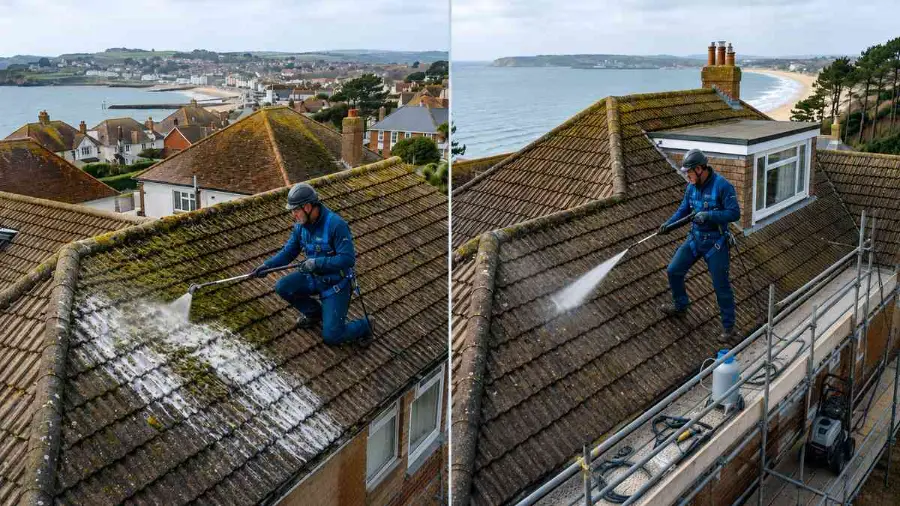
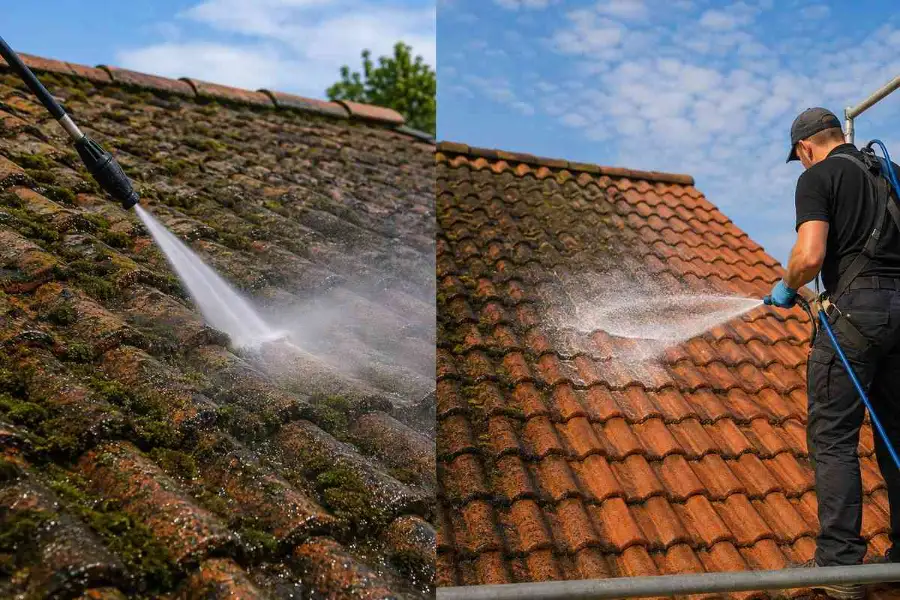
Pressure washing uses a high-output pressure washer to spray water at significantly higher force typically in the range of 1,300 to 4,000+ PSI directly onto the roof surface. This physically dislodges moss, dirt, lichen and algae through sheer mechanical force rather than chemical action.
It’s often faster than soft washing and, on the right surface, produces an immediately dramatic result. The problem is what “the right surface” means in practice. Pressure washing is genuinely well suited to hard, non-porous, ground-level or robust surfaces think driveways, patios, and some sound modern concrete tiles but roofs are a different category of surface entirely. Years of UK weather, freeze-thaw cycles and general wear leave most tiles more porous and fragile than they look from the ground, and high-pressure water can:
- Strip protective coatings or granules from tiles
- Crack, chip or dislodge tiles, especially aged or clay tiles
- Force water beneath tiles and into the underlying roof structure
- Remove visible growth while leaving root systems intact, meaning moss often returns within a year
That last point is the one most homeowners don’t find out until it’s too late a pressure-only clean can look fantastic on day one and be visibly regrowing moss by the following spring, because nothing addressed the biological growth at its source.
What Pressure Washing Is Best For
- Driveways, patios and other hard, ground-level surfaces (see our driveway & patio cleaning page for that side of things)
- Render and masonry in good condition
- Very heavily soiled, structurally sound modern tile where speed matters more than longevity
- Situations where a quick cosmetic improvement is genuinely all that’s needed
For a full breakdown of when we’d recommend it and how we calibrate pressure by surface, our pressure washing page covers the process in more depth.
Side-by-Side: Which Method Suits Which Roof Type?
| Roof Material | Recommended Method | Why |
|---|---|---|
| Concrete tile (modern, sound) | Either, soft wash preferred | Durable enough for pressure, but soft wash lasts longer |
| Concrete tile (aged/porous) | Soft washing | Reduces risk of cracking or granule loss |
| Clay tile | Soft washing | Porous surface, higher damage risk under pressure |
| Slate | Soft washing (or hand cleaning) | Brittle, easily chipped or cracked by high-pressure jets |
| Flat/felt roof | Neither specialist process | Requires a different cleaning approach entirely |
| Metal roofing | Pressure washing (low-medium PSI) | Durable surface, but still needs calibrated pressure |
Cost Comparison: Soft Wash vs Pressure Wash
On paper, pressure washing often comes out slightly cheaper per square metre, since it’s typically a faster job requiring less product and dwell time. But that comparison misses the bigger financial picture.
| Factor | Soft Wash | Pressure Wash |
|---|---|---|
| Typical cost per m² | Slightly higher | Slightly lower |
| Frequency needed | Every 2-4 years | Every 12-18 months |
| Risk of tile damage/repair cost | Low | Higher |
| Long-term cost over 5 years | Often lower overall | Often higher due to repeat cleans |
If you’re weighing this up specifically for your property, our full roof cleaning cost breakdown for Bournemouth covers pricing by roof size, material and access in detail — worth reading alongside this comparison before requesting quotes.
Common Myths About Soft Washing and Pressure Washing
“Pressure washing is always the more thorough clean.” Not true pressure removes what’s visible, soft washing removes what’s causing it. A roof can look identically clean immediately after either method; the difference shows up months later.
“Soft washing uses harsh chemicals that will kill my garden.” Reputable soft wash providers use biodegradable, roof-safe solutions and take precautions such as wetting down plants beforehand and using neutralising rinses to protect landscaping. Ask any contractor specifically what solution they use and how they protect surrounding plants.
“A higher PSI pressure washer always does a better job.” Higher pressure increases risk faster than it increases cleaning quality once you’re above what a given tile can safely tolerate. More force isn’t automatically better it’s a liability once it exceeds the material’s tolerance.
“Soft washing takes too long to be worth it.” The dwell time required for the biocide to work does make soft washing a longer job on-site, but the trade-off is a result that lasts two to four times longer before you need to book another clean.
How to Tell Which Method a Company Is Actually Using
Because “soft wash” has become something of a marketing buzzword, it’s worth asking direct questions before booking:
- What pressure (PSI) will be used on my roof?
- What cleaning solution or biocide is being applied?
- Is there a dwell time before rinsing, or is it a straight wash?
- Will you calibrate pressure differently depending on my tile type?
- What results should I expect to see in 12 months versus rinsing straight away?
A company genuinely offering a soft wash service should be able to answer all five without hesitation. If the answer to “what solution do you use” is vague, you may be paying soft-wash prices for a pressure-only job.
Can the Two Methods Be Combined?
In some cases, yes. A common professional approach on heavily soiled roofs is to use a very low-pressure rinse to remove loose surface debris first, followed by a proper soft wash biocide application to treat the underlying growth. This isn’t the same as full-force pressure washing it’s a calibrated, low-impact first pass that makes the chemical treatment more effective, not a substitute for it.
This combined approach tends to work particularly well after cleaning, when moss debris knocked loose during either process ends up washed straight into the gutters which is exactly why we’d always recommend a gutter clearing check alongside any roof clean, soft wash or pressure wash.
Which Method Do We Recommend for Bournemouth Roofs?
For the vast majority of properties across Bournemouth, Poole and Christchurch, soft washing is the method we recommend as standard, particularly given the coastal climate’s tendency to accelerate moss and algae regrowth. Pressure washing has its place mainly on ground-level hard surfaces and select modern, structurally sound tile where speed is the priority but as a roof cleaning method on its own, it’s rarely the better long-term choice.
That said, “it depends on your roof” isn’t a cop-out answer, it’s genuinely true. Tile age, material, pitch and how established any moss growth is all factor into the right call, which is why we always assess a roof in person before recommending a method rather than quoting blind over the phone.
Getting the Right Method for Your Roof
The Asphalt Roofing Manufacturers Association and most roofing material manufacturers explicitly recommend low-pressure biocide treatment over high-pressure washing to avoid voiding tile or shingle warranties a detail worth checking on your own roof’s documentation if you’re unsure which method is appropriate.
If you’re not sure which method is right for your property, the safest step is a proper on-site assessment rather than guessing from a phone call. We inspect the tile type, condition, pitch and moss severity before recommending a method, and we’re always upfront about which one we’re using and why. You can get a free written quote from our team and we’ll tell you honestly whether your roof needs a soft wash, a calibrated pressure clean, or a combination of both not whichever is quickest for us to book in.
Reference: National Federation of Roofing Contractors (NFRC) UK industry guidance on roof maintenance and cleaning best practice.