
“It wasn’t there last summer” is one of the most common things homeowners say when they finally book a roof clean and it’s usually not quite true. Fast moss growth on roofs rarely happens overnight; it happens quietly, in stages, for months before it becomes visible enough from the ground to notice. By the time you spot it, the colony is often already well established.
If you’re trying to work out how urgent your own roof situation is or you’re comparing “a bit of green” to what a neighbour’s roof looked like a year ago this guide breaks down the actual timeline: how fast moss spreads, what the early warning signs look like before it’s obvious, and why some Bournemouth roofs seem to regrow moss far faster than others.
The Short Answer: How Fast Does Moss Grow on a Roof?
Under favourable conditions consistent moisture, shade and organic debris moss can begin visible growth on a roof within 2 to 6 weeks, with noticeable patches forming within 2 to 3 months. Left untouched, a roof can develop substantial, roof-wide coverage within one to two growing seasons. In less favourable conditions (drier, sunnier, well-maintained roofs), that same process can take a year or more to reach the same visible stage.
The honest answer is that there’s no single fixed speed it depends heavily on rainfall, shade, roof material and how much organic debris (leaves, pollen, dust) is sitting on the tiles. But the pattern is consistent enough that it’s worth understanding in stages.
The Growth Stages of Moss on a Roof
Stage 1: Spore Settlement (Week 1-2)
Moss doesn’t arrive as a fully formed patch it starts as microscopic spores carried by wind, birds, or debris that land in the small crevices between tiles. At this stage, there’s nothing visible at all. The spores need consistent moisture to germinate, which is why this stage often coincides with a wet spell.
Stage 2: Germination and Early Growth (Week 2-6)
Once conditions are damp enough for long enough, spores germinate and begin forming tiny green filaments. This is usually the point where growth becomes technically “visible,” though in practice it’s often too small to notice unless you’re looking closely or using binoculars from the ground.
Stage 3: Establishment (Month 2-3)
This is where most homeowners actually first notice something. The colony thickens, develops a visible cushion-like texture, and starts to spread outward from its original point. Growth rate through this phase is commonly cited at somewhere between half an inch and a full inch per week under consistently damp, shaded conditions — considerably faster than moss growing in a garden setting, because roof tiles hold surface moisture differently to soil.
Stage 4: Colonisation and Spread (Month 3-12)
Once established, moss expands laterally across the tile surface, often following the line of least resistance tile joints, valleys, and areas where water naturally channels. This is also the stage where moss starts actively retaining water against the tile, which is when the real structural risk begins, well before the growth looks dramatic from the street.
Stage 5: Maturity and Full Coverage (Year 1-2)
Left entirely untreated, a roof section in ideal conditions can reach dense, established coverage within one to two years. At this point regrowth is self-sustaining — the moss itself now creates the organic debris and moisture-holding conditions that support further spread, effectively feeding its own expansion.
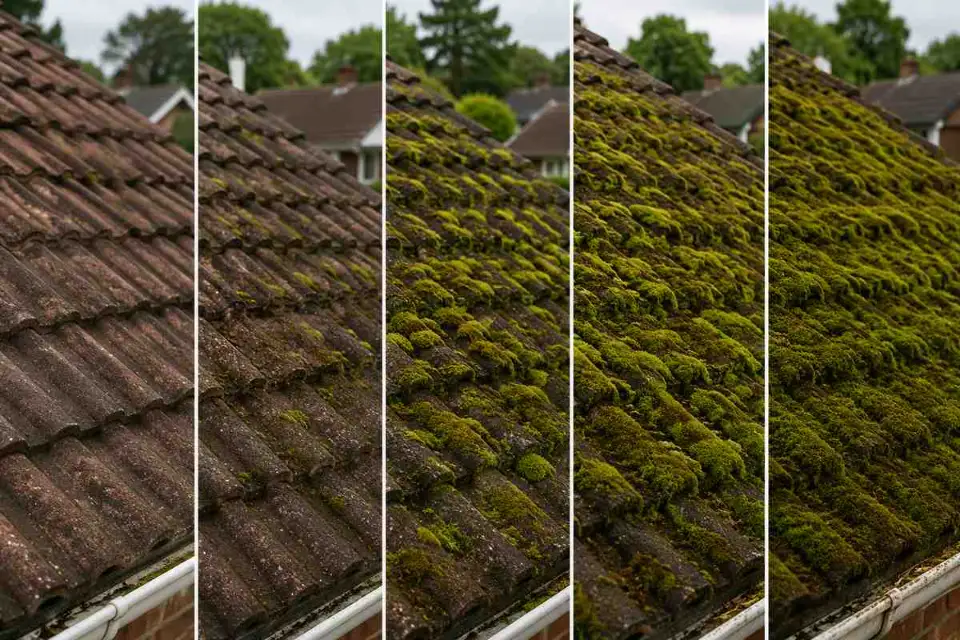
Moss growth isn’t linear. It typically looks like almost nothing is happening for the first month or two, then appears to “suddenly” take over within a matter of weeks. What’s actually happening is the colony reaching Stage 3 the acceleration was always coming, it just wasn’t visible yet.
Why Growth Speed Varies So Much Between Roofs
Two houses on the same street can have dramatically different moss timelines. The variables that speed growth up or slow it down are fairly predictable once you know what to look for:
| Factor | Effect on Growth Speed |
|---|---|
| Shade (trees, north-facing aspect) | Significantly faster |
| Consistent rainfall/humidity | Faster |
| Roof pitch (shallow vs steep) | Shallow pitch = faster (water drains slower) |
| Tile porosity/age | Older, more porous tiles = faster |
| Organic debris (leaves, moss from previous growth) | Faster, provides nutrients |
| Direct sunlight exposure | Slower |
| Good drainage/clear gutters | Slower |
| Previous professional treatment | Significantly slower regrowth |
This is one reason two neighbouring roofs cleaned on the same day can look completely different eighteen months later one shaded and north-facing, one open and south-facing, with everything else roughly equal.
Early Warning Signs Before Moss Is Obvious
Because the early stages are so hard to spot from ground level, it helps to know what to look for before it becomes a full-blown problem:
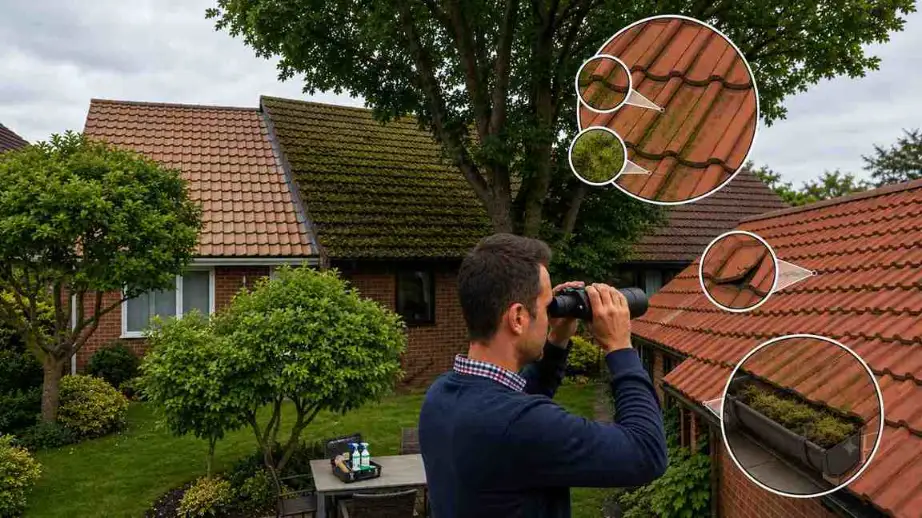
- Slight discolouration or darkening in shaded tile sections, often mistaken for dirt
- A slightly fuzzy or textured appearance on close inspection, rather than a smooth tile surface
- Small patches of green concentrated at tile joints or valleys, rather than spread evenly
- Debris build-up in gutters or roof valleys, which often precedes visible moss by weeks
- Persistent damp patches that stay visibly darker/wetter than surrounding tile after rain has otherwise dried
A good pair of binoculars checked from the garden every few months will usually catch these signs well before moss reaches the fast-spreading Stage 3 phase. If you’re already seeing a mature patch, our roof moss removal service covers what treatment looks like once growth is established.
Does Regrowth Speed Change After a Professional Clean?
This is one of the most common questions we get, and the honest answer depends heavily on which cleaning method was used originally.
- After a soft wash with biocide treatment: regrowth is typically slowed significantly, since the treatment addresses spores and root-level growth rather than just what’s visible. Many properties go 2-4 years before needing another clean.
- After a pressure-only wash: visible moss is removed, but spores and root structures often survive, meaning regrowth can restart at Stage 2 within months rather than years.
If you’re trying to understand which approach actually slows this cycle down, our comparison of soft wash vs pressure wash roof cleaning covers exactly why the method matters more than most homeowners expect.
How Local Climate Affects the Timeline
Growth speed isn’t just about an individual roof’s shade and pitch regional climate sets the baseline everyone in that area is working against. Coastal towns with higher humidity and milder winters tend to sit at the faster end of every stage described above, since spores rarely face the harsh dry-out or deep-frost conditions that slow germination elsewhere in the UK. We’ve covered exactly why that’s the case locally in our guide to why moss grows fast on roofs in Dorset’s coastal climate worth reading alongside this timeline if you want the full picture of cause and speed together.
A Realistic Monitoring Schedule
Given how much regrowth speed varies by property, a practical approach beats a fixed calendar reminder:
| Roof Situation | Suggested Check Frequency |
|---|---|
| Shaded, north-facing, tree cover nearby | Every 6 months |
| Standard suburban roof, partial shade | Annually |
| Open, south-facing, minimal shade | Every 12-18 months |
| Recently professionally soft-washed | Annually as a precaution |
A quick visual check with binoculars costs nothing and catches Stage 2-3 growth before it reaches the point of holding real moisture against your tiles.
What Happens If You Let It Reach Full Maturity?
The risk isn’t just aesthetic. Mature moss growth retains substantial water against the tile surface for extended periods, and that sustained dampness is what causes the structural issues homeowners actually end up paying to fix:
- Tiles lifted or dislodged by root-level growth between joints
- Gutters blocked by moss debris washed down during rain worth checking via our gutter cleaning service if this has already happened
- Damp penetration into the roof structure over multiple years of untreated growth
- A shortened overall lifespan for the tiles themselves
The gap between “a bit of green in the valleys” and “moss holding water against the tile year-round” is often smaller, timeline-wise, than people expect which is exactly why catching it in Stage 2 or 3 rather than Stage 5 makes such a difference to both cost and disruption.
Getting an Accurate Read on Your Own Roof
Photos from the ground can be deceiving what looks like light surface discolouration can already be established Stage 3 growth once you’re up close, and what looks alarming from a distance is sometimes just water staining rather than moss at all. If you’re not sure which stage your roof is actually at, or how urgently it needs attention, the most reliable option is a proper visual inspection rather than guessing from the garden.
You can get a free, no-obligation roof assessment from our team we’ll tell you honestly what stage any growth is at, how fast it’s likely to progress given your roof’s shade and orientation, and whether it’s something to deal with now or something you can reasonably monitor for another season.
Reference: Royal Horticultural Society – Moss Biology and Growth general growth and biology information for moss species common in UK conditions.