
If you’ve just had your roof cleaned, there’s a good chance you’re standing back admiring spotless tiles, a fresh ridge line and a roofline that finally looks the way it did when the house was built. It’s a satisfying moment. But there’s one part of the job that homeowners across Bournemouth, Poole and Christchurch often overlook once the scaffolding comes down and the moss is gone: the gutters.
A roof clean and a gutter clean are two different jobs that solve two very different problems, yet they’re deeply connected. Skip one after finishing the other and you can undo a lot of the good work in a single wet Dorset winter. This guide walks through exactly why gutter cleaning belongs on your to-do list straight after a roof clean, what happens if you leave it, and how the two services work together to protect your property for years rather than months.
Why Roof Cleaning and Gutter Cleaning Are Two Halves of the Same Job
A roof cleaning service strips moss, algae, lichen and general grime off the tiles themselves. It’s about the surface you see from the street. Gutter cleaning deals with the drainage system that sits directly beneath that surface, catching everything that runs off the roof and channelling it safely away from your walls, foundations and windows.
Here’s the part most people don’t think about: cleaning a roof doesn’t remove growth from a static surface — it dislodges it. Manual moss scraping, soft washing and biocide treatment all loosen debris that has been sitting on the tiles, sometimes for years. Gravity does the rest, and gravity always sends things downhill, straight into the gutter line.
A roof that’s just been cleaned is, for a short window, actually more likely to shed debris into the gutters than one that’s been left untouched for a season. That’s not a reason to skip the clean — it’s the reason gutter clearance has to follow it.
If your gutters were already partially blocked before the roof work started, that dislodged material has nowhere to go. It sits on top of the existing blockage, and instead of a roof clean improving your drainage, it can quietly make it worse.
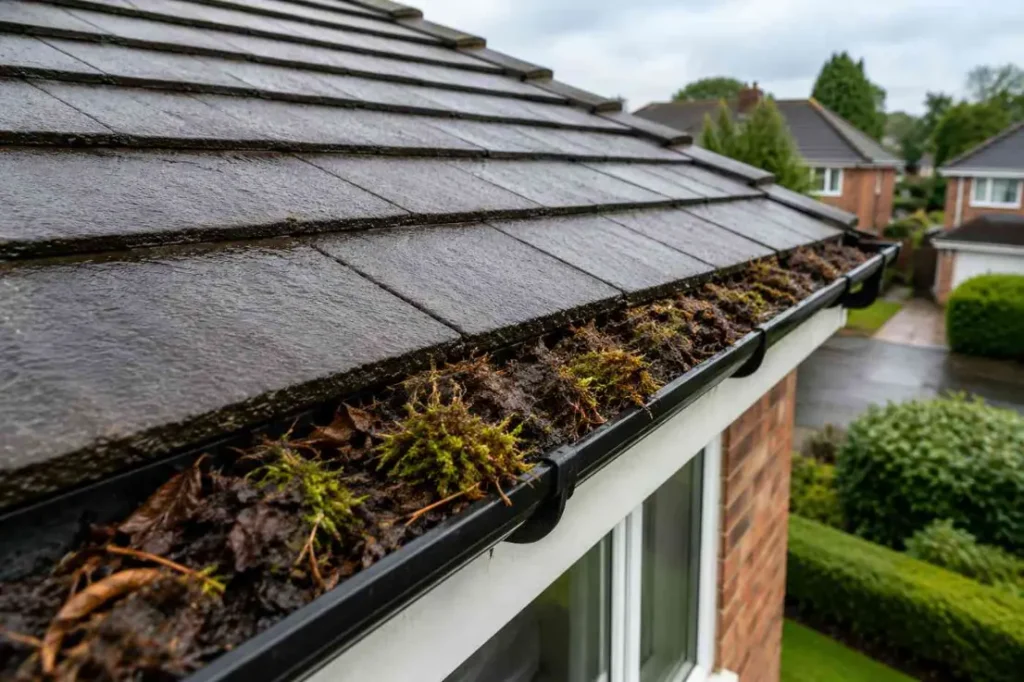
What Actually Ends Up in Your Gutters After a Roof Clean
During a professional roof moss removal and soft wash, several types of debris get released from the tile surface and travel down towards the gutter line:
- Loosened moss clumps — dead moss that was killed by biocide treatment eventually detaches and washes down
- Lichen fragments — brittle and prone to breaking apart during manual scraping
- Fine grit and tile sediment — especially on older concrete tiles that have started to shed granules
- Algae residue — black streaking that softens and rinses off during the wash stage
- Twigs, leaves and general roof debris — dislodged from valleys and behind chimneys where it’s been trapped for months
None of this is a sign of a bad roof clean. It’s a completely normal by-product of a thorough one. The issue only arises if the gutters aren’t checked and cleared afterwards, because all of that material ends up concentrated in one place — sitting in the gutter run, exactly where it can do the most damage.
The Real Risks of Skipping Gutter Cleaning After a Roof Wash
Standing Water and Overflow
Blocked gutters can’t move water where it needs to go. During Bournemouth’s wetter months, that means water backs up, overflows the front edge and runs straight down your fascia boards and render instead of through the downpipe. Over time this leads to staining, damp patches and, in older properties, water tracking into the wall cavity.
Frost Damage in Winter
Standing water in a blocked gutter freezes when temperatures drop. Ice expands as it forms, and repeated freeze-thaw cycles through a Dorset winter can crack uPVC gutter sections, pull brackets away from the fascia and warp joints that were perfectly fine in autumn.
Undermining the Roof Clean Itself
This is the part that catches people out. If dislodged moss and debris sit wet in a blocked gutter, that damp environment becomes an ideal spot for new algae and moss spores to establish themselves. Spores don’t need much — just moisture and organic material — and a clogged gutter offers both in abundance. You can end up with regrowth creeping back up onto the lower courses of tiles within a single season, undermining the very treatment you just paid for.
Fascia and Soffit Deterioration
Overflowing water doesn’t just run down the wall — it sits against the soffit and fascia boards directly behind the gutter. Constant moisture exposure causes uPVC to discolour and, on timber fascias, leads to rot that can be expensive to put right. A roofline that’s just been cleaned and looks bright white can start staining green again within months if the gutter above it is overflowing.
Pest Attraction
Damp, debris-filled gutters are attractive to insects and, in some cases, nesting birds. A blocked gutter effectively becomes a small, elevated compost bin sitting right against your roofline.
Signs Your Gutters Need Attention After a Roof Clean
You don’t need to get on a ladder to spot most of these warning signs from ground level:
| Sign | What It Usually Means |
|---|---|
| Water streaking down the wall during rain | Overflow from a blocked or overfull section |
| Plants or moss visibly growing in the gutter line | Organic build-up has been sitting long enough to root |
| Sagging or uneven gutter sections | Weight of trapped debris and water pulling on brackets |
| Damp patches on interior ceilings near external walls | Water tracking in through an overflow point |
| Green or black staining reappearing on fascias | Water overflow depositing algae onto the roofline |
| Pooling water at the base of downpipes | Reduced flow rate caused by upstream blockage |
If you’re seeing any of these within a few weeks of a roof clean, it’s almost always debris that’s washed down and settled rather than a fault with the roof work itself.
How Professional Gutter Cleaning Solves the Problem
A proper gutter cleaning service does more than pull out a handful of leaves. Modern gutter vacuum systems, like the SkyVac technology used across most professional jobs in Bournemouth, clear the full length of the run from ground level, reaching debris that’s packed down at the bottom of the channel — not just what’s visible from below.
A thorough job typically includes:
- Full-length vacuum clearance of leaves, moss, grit and sediment from every metre of guttering
- Downpipe checks to confirm water is flowing freely and nothing has lodged further down the system
- Visual inspection of brackets, joints and seals for movement, cracking or gaps
- Photo evidence before and after, so you can see exactly what’s been cleared
- Flow testing where appropriate, to confirm the system is draining correctly
Timing this straight after a roof clean means you’re clearing out the debris while it’s still loose and fresh, rather than waiting for it to compact and bond with older material over the following months.
How Often Should Gutters Be Cleaned in Bournemouth?
Most homes benefit from a gutter clean twice a year — typically in late spring and again in autumn once the leaves have dropped. Properties near mature trees, or in leafier neighbourhoods like Southbourne, Charminster or Wimborne, often need a third visit. If you’ve just had a roof clean completed, it’s worth treating that as an additional, one-off clearance regardless of when your last scheduled clean was, simply because of the extra debris the roof work has released.
Coastal exposure is also a factor here in Dorset. Salt-laden air and higher humidity along the Bournemouth and Poole coastline tend to accelerate algae growth compared with inland areas, which is one of several regional weather patterns documented by the Met Office for the south coast. That extra moisture is exactly the kind of environment blocked gutters thrive in, which is another reason not to leave clearance too long after roof work finishes.
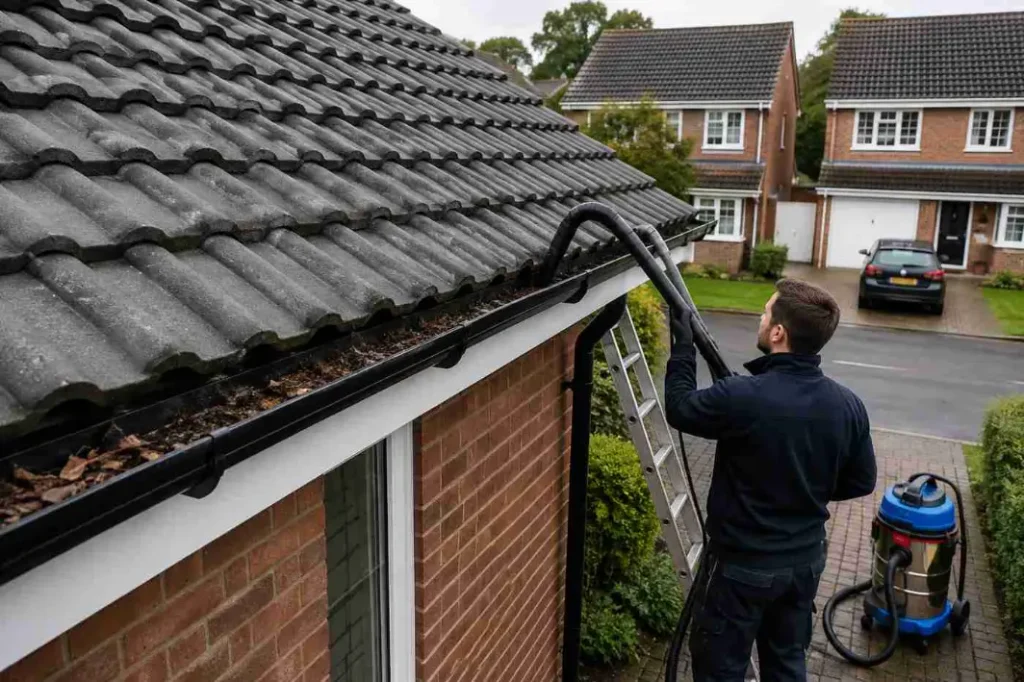
Combining Roof and Gutter Cleaning: The Smarter Approach
Booking both services together rather than as separate jobs weeks apart has some clear practical advantages:
- One access setup — ladders, safety equipment and site access are only arranged once
- No debris left behind — anything dislodged during the roof clean is cleared in the same visit
- Better long-term protection — a roof coating and sealing treatment performs better when the drainage system underneath it is also clear and functioning properly
- Cost efficiency — most Bournemouth cleaning companies, including ours, offer a discount when services are combined into a single visit
- Complete before-and-after picture — you get a full record of the roof, gutters, fascias and soffits all handled together, rather than a partial job
If you’ve read our earlier piece on how fast moss actually grows on a roof, you’ll know that regrowth often starts in the damp, shaded lower sections of a roof — precisely the areas closest to the gutter line. Keeping that drainage clear is one of the simplest ways to slow that regrowth cycle down.
Frequently Asked Questions
Do I need to clean my gutters every time I have my roof cleaned? Yes, or at the very least have them checked. Even a light roof clean dislodges some debris, and a full moss removal and soft wash releases considerably more. Skipping the gutter check afterwards is the most common reason homeowners see disappointing results within the first year.
Can blocked gutters actually cause roof damage? Indirectly, yes. Water that can’t drain properly backs up under the lower courses of tiles, which can lead to damp penetration, timber rot in the roof structure, and conditions that encourage fresh moss growth right at the eaves.
How do I know if my gutters were cleared during my roof clean? A reputable company will tell you upfront whether gutter clearance is included or offered as an add-on, and should provide photo evidence either way. If you’re unsure, it’s worth asking directly before booking.
Is it worth getting soffit and fascia cleaning done at the same time? Generally yes. Since overflow and splashback from blocked gutters is what stains fascias and soffits in the first place, cleaning all three together gives a more complete and longer-lasting result than treating them separately.
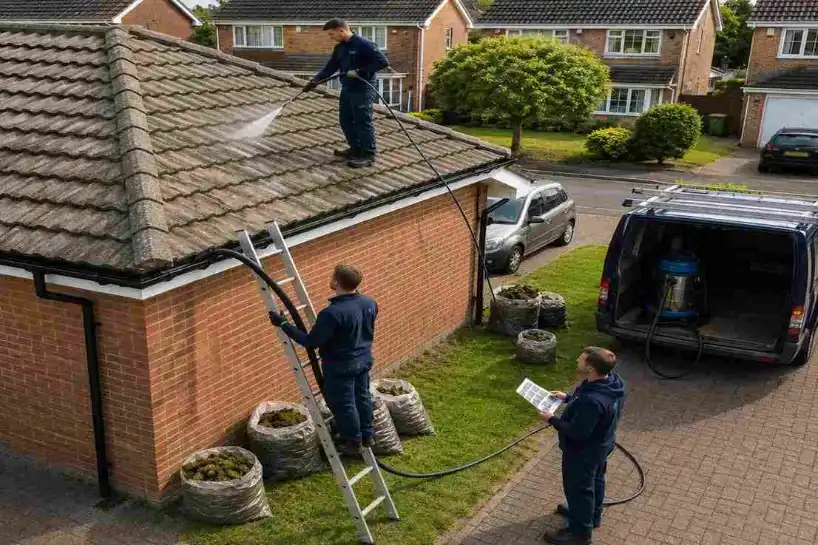
Getting Your Roof and Gutters Sorted Together
A clean roof and blocked gutters is a combination that rarely lasts. If you’ve recently had roofing work done — or you’re planning it — it’s worth having the gutters assessed in the same visit rather than treating it as a separate job for another day. It’s a small addition that protects the investment you’ve already made in the roof itself.
If you’re in Bournemouth, Poole, Christchurch or anywhere across Dorset and want a free, no-obligation quote covering roof cleaning, gutter clearance, or both together, get in touch through our contact page and we’ll arrange a convenient time to take a look.